-
Fast, Free Shipping

-
Buy now, pay later

-
Hassle-Free Warranty

-
Lifetime Customer Support


⚡Pre-sale⚡WattCycle 48V 100Ah LiFePO4 Server Rack Battery for Home Battery Storage System
The pre-sale price is £859.99. Once it is back in stock, the price will increase to £899.99.
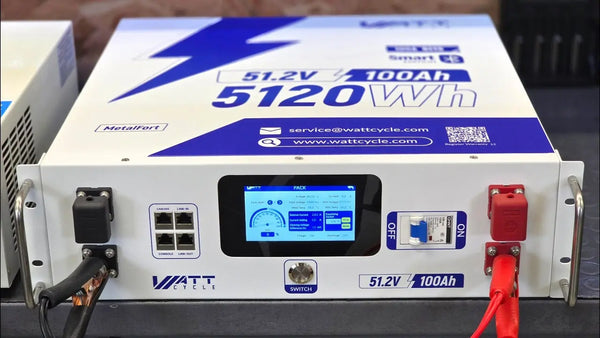
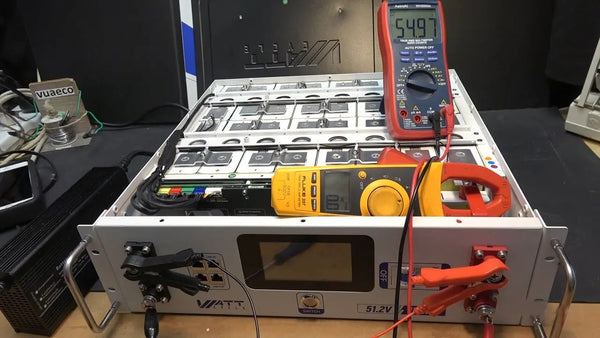
- L485 x W450 x H133 mm, 41,7kg, compatible with 19-inch server rack
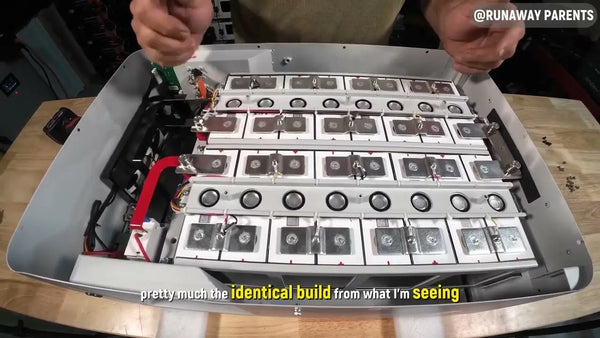
- 3A active balance provides faster multi-channel equalisation efficiency, reduces energy loss, and maximises battery life.
- LCD touchscreen helps you monitor and check the battery at a glance
- Bluetooth & Password Protection via WattCycle App
- Triple communication mode: CAN/RS232/RS485
- 100A BMS, 100A Max. Cont. Dis-/Charge Current
- IP20 waterproof/dustproof, supports floor-stand installation
- 5.12kWh usable energy in one unit
- Supports 20P to achieve Max. 102,4 kWh energy
Shipping time
Our shipping time is divided into two parts, starting from the time you place your order:
Processing time: 1-2 business days
Shipping time: 1-3 business days
Attention: The above transit time is for reference only and applies to most orders. It does not include inspection time, other special circumstances, or uncontrollable factors such as natural disasters, congestion, etc.
Shipping cost
All WattCycle orders are FREE SHIPPING.
The shipping will be delayed for some objective or uncontrolled reasons. We will notify our customers ahead of delays.
Local UK warehouse, more details in
Shipping Policy
Our batteries come with a 5-year warranty, which can be extended to 7 years total upon product registration.
For full terms, conditions, and claim details, please visit: Warranty
-
Fast, Free Shipping
-
Buy now, pay later
-
Hassle-Free Warranty
-
Lifetime Customer Support



Broad Inverter Compatibility
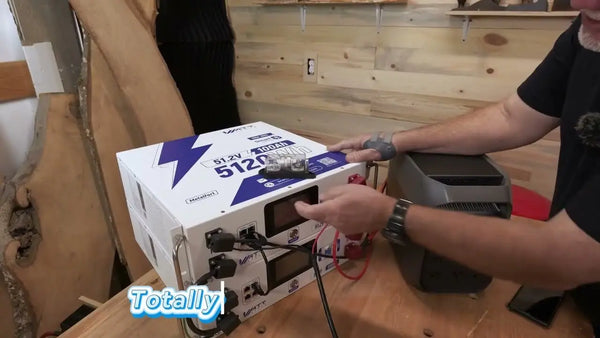
The WattCycle 48V 100Ah Server Rack Battery is designed to scale with your energy needs, supporting expansion up to 20 batteries for streamlined system integration. CAN, RS485, and RS232 communication protocols ensure compatibility with a wide range of inverter brands.

Space-Saving Design, Scalable Energy Storage
The WattCycle 3U Rack battery is suitable for small spaces with simple plug-and-play functionality. Expansion is as easy as building with blocks, ensuring every inch of space is utilized! Whether for emergency power needs or everyday electricity usage, it provides a continuous and stable power supply, eliminating energy worries.

Tech Specifications
General
| Battery Technology | LiFePO4 |
| Battery BMS | Self-developed BMS |
| Dimensions | L485mm x W450mm x H133 mm |
| Weight | 41.7 kg |
| Communication Ports | RS232/RS485/CAN |
| Terminals | M8 Bolts |
| Casing Material | Metal Casing |
| Waterproof Rating | IP20 |
| Self-heating | No |
| Hazard class | 9 |
| Warranty | 5+2 Years |
| Certifications | CE/FCC/UN38.3 |
Technical Data
| Nominal Voltage | 51,2V |
| Nominal/Usable Capacity | 100Ah |
| Energy | 5120Wh |
| Cell Balancing | Yes, 3A active balancing |
| Monthly Self Discharge | ≤3%/Month |
| Series & Parallel Configurations | Max. 20 in Parallel |
BMS
| BMS | 100A |
| Max. Continuous Output Power | 5120W |
| Standard Charging Voltage | 57,2±1,2V |
| Shipping Voltage | 51,2V - 58,4V |
| Standard Continuous Charge Current | 20A (0.2C) |
| Max. Continuous Charge/Discharge Current | 100A (1C) |
| Over-current Charge Protection | 110A±10A |
| Over-current Discharge Protection | 120A±10A / 10s |
| BMS High Temperature Cut-Off | Charge: 55℃±5℃ Discharge: 65℃±5℃ |
| BMS Low Temperature Cut-Off | Charge: 0℃±5℃ Discharge: - 20℃±5℃ |
| High Temperature Recovery | Charge: 50℃±5℃ Discharge: 60℃±5℃ |
| Low Temperature Recovery | Charge: 2℃±5℃ Discharge: -15℃±5℃ |
Temperature Range
| Charging Temperature | 0℃-55℃ |
| Discharging Temperature | -20℃-60℃ |
| Storage Temperature | 0℃-45℃ |
Compatible Inverters
| Inverter Brands | Communication Ports |
|---|---|
| Afore | CAN |
| Aiswei | CAN |
| Aohai | RS485 |
| Deye | CAN |
| GOODWE | CAN |
| GROWATT | RS485/CAN |
| GT | RS485 |
| Hoymiles | CAN |
| INVT | CAN |
| LUXPOWER | CAN |
| MEGAREVO | CAN |
| MUST | CAN |
| MUST | RS485 |
| NEXT | 232 |
| PYLON TECH | RS485/CAN |
| SAJ | CAN |
| SAKO | RS485 |
| Sacolar | RS485 |
| Senergy | CAN |
| SMA | CAN |
| SOFAR | CAN |
| SOLAX | RS485/CAN |
| Solis | CAN |
| SOROTEC | CAN |
| SRNE | RS485 |
| Studer | CAN |
| Sumry | RS485 |
| SUYEEGO | RS485 |
| TBB | CAN |
| Techfine | RS485 |
| VICTRON | CAN |
| Voltronic | RS485 |
Frequently Asked Questions
For a typical UK household with solar panels, a 5.12kWh battery can help store excess daytime solar energy and use it during the evening when electricity demand is highest.
Depending on energy usage and tariff rates, many households can save between £300–£800 per year by increasing self-consumption and reducing reliance on grid electricity.
The payback period depends on electricity prices, solar generation and energy usage patterns.
For many UK homes using solar panels, a battery storage system can typically pay for itself within 4–8 years, while continuing to provide savings for many years afterwards.
With 6000+ cycle life, this battery is designed to deliver value well beyond the payback period.
Many users choose server rack batteries because they offer significantly more storage capacity per pound spent.
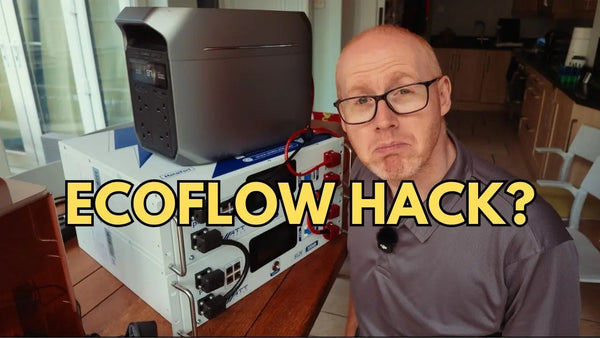
A single WattCycle 48V 100Ah battery provides 5.12kWh of storage, allowing users to expand their EcoFlow system at a lower cost per kWh compared with many OEM expansion battery options. Community discussions frequently highlight the cost-per-kWh advantage of 48V server rack batteries.
LiFePO4 batteries typically last several times longer than lead-acid batteries and provide more usable energy.
Although the upfront cost is higher, the cost per cycle is significantly lower, making LiFePO4 one of the most economical long-term energy storage solutions for UK homes.
Yes.
By storing solar energy during the day and using it in the evening, homeowners can increase self-consumption and reduce the amount of electricity purchased from the grid.
For many solar users, battery storage is one of the most effective ways to improve energy independence.
Yes. It supports simultaneous charging and discharging, making it suitable for solar self-consumption systems where energy is used and stored at the same time.
A 48V 100Ah LiFePO4 battery typically lasts over 6000 charge cycles, which is equivalent to around 10–15 years of daily use depending on operating conditions, depth of discharge, and usage patterns.
This makes it significantly longer-lasting than traditional lead-acid batteries, which usually last only 2–5 years.
In a typical UK household, a 5kWh LiFePO4 battery will usually last through the night when running essential appliances such as a fridge, WiFi router, and lighting.
In most cases, this means around 8 to 14 hours of reliable usage, depending on how many devices are running at the same time.
If the usage is light, for example only keeping essential standby appliances running, it can stretch closer to a full day.
A single 5kWh battery is generally not enough to run an entire UK home independently.
Instead, it is more commonly used to support essential circuits during power cuts or to store excess solar energy for use in the evening and night.
For full household coverage, most UK homes combine multiple batteries rather than relying on just one unit.
Most UK solar setups fall into three practical categories.
A single battery is usually used for emergency backup only.Two to three batteries are commonly used for everyday solar self-consumption in typical homes.Four or more batteries are typically needed if the goal is near off-grid independence.
In real UK installations, the most common choice is two to three units, as this provides a good balance between cost, storage capacity, and energy independence.
A 5kWh battery is well suited for keeping essential household devices running.
For example, it can usually keep a fridge running overnight and into the next day, power WiFi for several days, and support lighting for one to two evenings.However, appliances that draw a lot of power, such as kettles, ovens, or electric heaters, will use up the stored energy very quickly and are not ideal for battery operation.
For UK solar systems, LiFePO4 batteries are widely considered a much better long-term option than traditional lead-acid batteries.They typically last several times longer, allow more of their stored energy to be used, and do not require maintenance.
Over time, this usually results in lower total cost of ownership, even though the upfront price is higher.
Most modern UK home solar systems use 48V batteries because they are more efficient for higher power loads and larger storage capacity.Compared to 12V systems, they reduce energy loss, handle higher loads more safely, and scale much better when multiple batteries are connected together.
This makes 48V the standard choice for residential solar storage in the UK.
Yes, this type of 48V LiFePO4 battery is compatible with most modern UK solar systems.
It typically works with hybrid inverters and MPPT charge controllers from popular brands used in residential solar installations.As with any battery system, correct voltage matching and inverter compatibility should always be checked before installation.
In everyday UK residential use, a LiFePO4 battery is generally expected to last around 8 to 12 years.This is based on regular daily charging and discharging through a typical solar system.
Because UK temperatures are relatively moderate, batteries often perform more consistently compared to hotter climates.
Active balancing helps keep all internal cells inside the battery at the same voltage level during charging and discharging.
This improves overall efficiency, ensures more usable capacity over time, and helps extend the battery’s lifespan.It is especially useful in systems where multiple batteries are used together.
Compared to traditional lead-acid systems, LiFePO4 offers significantly longer lifespan, higher usable capacity, and better long-term efficiency.
Compared to many entry-level battery systems, it also provides more stable performance over repeated daily cycling, which is important for UK solar users who rely on consistent storage throughout the year.In most long-term UK solar installations, LiFePO4 is chosen because it delivers better lifetime value rather than just a lower upfront cost.
A single unit provides 5.12kWh of energy. For a typical home backup load of 500W (including a fridge, lights, and router), it can run for approximately 9–10 hours (at 90% Depth of Discharge).
Most 48V batteries use passive balancing (only 0.05A–0.1A). Our 3A active balanceris up to 30x faster, transferring energy from high-voltage to low-voltage cells in real-time. This prevents premature system shutdowns and extends the overall lifespan by ensuring cell consistency.
It supportsclosed-loop communicationvia CAN/RS485 with major brands including Victron, Growatt, Deye, Luxpower, and Solark. It can also work in open-loop mode with almost any 48V hybrid inverter on the market.
You can connect up to20 units in parallel, expanding your total capacity to 102.4kWh. This modular design allows you to start small and scale up as your home energy needs grow.